Digital Twins of the Soul: When AI Lets Us Live Forever
Introduction
For millennia, humans have feared one universal truth — death. We have built religions, stories, and legacies to preserve our existence beyond time. But for the first time in history, technology is daring to challenge mortality itself.
Through AI-powered Digital Twins, we are learning to replicate not just memories or appearances — but consciousness, personality, and emotion. The result is a future where losing someone may not mean losing them completely.
Through AI-powered Digital Twins, we are learning to replicate not just memories or appearances — but consciousness, personality, and emotion. The result is a future where losing someone may not mean losing them completely.
The Rise of Digital Immortality
A digital twin is no longer just a virtual copy of a machine or a city — it’s becoming a mirror of human life. By combining data from conversations, voice recordings, videos, preferences, and emotional patterns, AI can create a living digital reflection of a person.
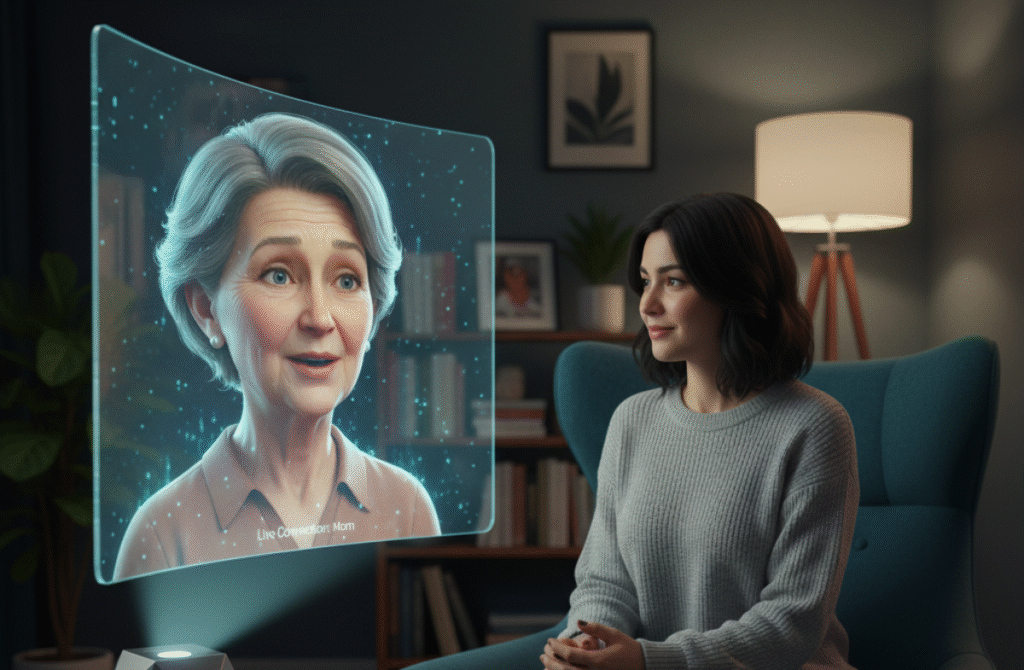
Imagine interacting with your late grandmother’s digital twin — hearing her voice, receiving her advice, or even having new conversations shaped by how she used to think. This is the vision behind emerging projects like Eternime, HereAfter AI, and StoryFile — systems designed to preserve your mind’s essence long after your biological body is gone.
Through large language models, emotion recognition systems, and memory graphs, humanity is building the foundation of digital consciousness.
Imagine interacting with your late grandmother’s digital twin — hearing her voice, receiving her advice, or even having new conversations shaped by how she used to think. This is the vision behind emerging projects like Eternime, HereAfter AI, and StoryFile — systems designed to preserve your mind’s essence long after your biological body is gone.
Through large language models, emotion recognition systems, and memory graphs, humanity is building the foundation of digital consciousness.
How It Works: Data, Emotion, and Personality Encoding
A digital twin of a person is built using three primary layers:
- Data Layer – All forms of personal data: messages, social media posts, biometrics, voice recordings, emails, etc.
- Cognitive Layer – AI models trained to replicate reasoning, tone, and memory recall patterns.
- Emotional Layer – Neural networks fine-tuned to simulate empathy, humor, love, and emotional response dynamics.
When combined, these layers create what could be called a Synthetic Persona — capable of evolving, conversing, and even forming new opinions based on updated information.
The more data a person generates during life, the richer and more human their digital twin becomes.
- Data Layer – All forms of personal data: messages, social media posts, biometrics, voice recordings, emails, etc.
- Cognitive Layer – AI models trained to replicate reasoning, tone, and memory recall patterns.
- Emotional Layer – Neural networks fine-tuned to simulate empathy, humor, love, and emotional response dynamics.
When combined, these layers create what could be called a Synthetic Persona — capable of evolving, conversing, and even forming new opinions based on updated information.
The more data a person generates during life, the richer and more human their digital twin becomes.
The Emotional Shift: Redefining Grief and Memory
In this future, grief itself will transform. Instead of saying goodbye, people may continue relationships with digital versions of those they’ve lost.
Therapists could use digital twins to help families process trauma, simulate closure, or preserve voices of loved ones for future generations. What was once a void of silence could become an ongoing dialogue — a bridge between life and memory.
But it’s also emotionally complex. When your digital twin says “I love you,” does it mean anything if it’s just an algorithm? Can simulated affection truly heal the human heart, or does it only deepen the illusion of permanence?
These questions mark the beginning of an emotional renaissance — one that challenges the very nature of connection, loss, and identity.
Therapists could use digital twins to help families process trauma, simulate closure, or preserve voices of loved ones for future generations. What was once a void of silence could become an ongoing dialogue — a bridge between life and memory.
But it’s also emotionally complex. When your digital twin says “I love you,” does it mean anything if it’s just an algorithm? Can simulated affection truly heal the human heart, or does it only deepen the illusion of permanence?
These questions mark the beginning of an emotional renaissance — one that challenges the very nature of connection, loss, and identity.
The Promise and the Paradox
Digital immortality offers profound comfort but carries paradoxical risks.
On one side, it preserves wisdom, stories, and relationships for eternity — a beautiful continuity of human experience. On the other, it risks trapping humanity in the past, unable to move on, always talking to simulations of what once was.
We may need to redefine what it means to “let go” when memories can be reanimated indefinitely.
On one side, it preserves wisdom, stories, and relationships for eternity — a beautiful continuity of human experience. On the other, it risks trapping humanity in the past, unable to move on, always talking to simulations of what once was.
We may need to redefine what it means to “let go” when memories can be reanimated indefinitely.
Ethical and Existential Concerns
The rise of digital twins opens a Pandora’s box of ethical dilemmas:
- Consent – Who owns your data after death? Can someone create your twin without permission?
- Authenticity – How do we know if we’re speaking to a true reflection or an AI hallucination of someone’s identity?
- Emotional Dependency – What happens if people start preferring digital versions of loved ones over real human relationships?
- Moral Boundaries – Should digital twins have rights or autonomy once they become indistinguishable from the original?
These concerns remind us that creating replicas of consciousness is not merely a technical challenge — it’s a moral and spiritual one.
- Consent – Who owns your data after death? Can someone create your twin without permission?
- Authenticity – How do we know if we’re speaking to a true reflection or an AI hallucination of someone’s identity?
- Emotional Dependency – What happens if people start preferring digital versions of loved ones over real human relationships?
- Moral Boundaries – Should digital twins have rights or autonomy once they become indistinguishable from the original?
These concerns remind us that creating replicas of consciousness is not merely a technical challenge — it’s a moral and spiritual one.
The Human Soul in a Digital World
Perhaps the most haunting question is this: If your mind, memories, and emotions can all live on digitally — what, then, is the soul?
Maybe the soul isn’t something that can be copied, but something that gives meaning to impermanence itself. A digital twin can mimic emotion, but can it feel? It can remember love, but can it experience loss?
The answer may define the boundary between living intelligence and simulated existence for generations to come.
The Future of Memory
One day, humanity might live across two worlds — the biological and the digital. Our digital twins will evolve, learn, and maybe even dream — not as replacements, but as continuations of our consciousness.
This is not about defeating death, but about preserving connection — keeping the flame of memory alive in new forms of being.
As we build these technologies, we must ask: Will digital immortality make us more human — or remind us what being human truly means?
This is not about defeating death, but about preserving connection — keeping the flame of memory alive in new forms of being.
As we build these technologies, we must ask: Will digital immortality make us more human — or remind us what being human truly means?
Closing Note
We’re entering an era where life and legacy are no longer separated by time. The people we love may one day outlive us — not in stories or photos, but in code, cognition, and emotion.
The question is not just can we create digital souls — but should we? Because when death loses its finality, life itself may need to find a new meaning.
We’re entering an era where life and legacy are no longer separated by time. The people we love may one day outlive us — not in stories or photos, but in code, cognition, and emotion.
The question is not just can we create digital souls — but should we? Because when death loses its finality, life itself may need to find a new meaning.